Friday, November 13, 2009

SHEL DORF, 1933 - 2009

Shel Dorf presenting the Inkpot Award to Milton Caniff, San Diego, 1982 (photo by Alan Light)

News spread quickly in the past two weeks about the death of Shel Dorf on November 3rd after a long illness. There have been several obituaries on Dorf, some remembrances from friends like Mark Evanier and R.C. Harvey, and a special tribute site. The press obits all focus on Dorf's role as a founder of San Diego Comic-Con, the largest comics convention in the world. I'd like to spotlight Dorf's relationship with Milton Caniff.

Masthead of Dorf's editorial column from 'Steve Canyon Magazine'

Shel Dorf lived every fan's dream. Growing up, he read, clipped, collected and marveled at comic strips. "Why are you clipping out comic strips?" asked his concerned mother, "You don't see other people doing that." He went further by sending fan mail to cartoonists and establishing friendships with his heroes. One of those he admired most was Milton Caniff, who corresponded by mail and later invited Dorf to his studio in 1964. Caniff honored Dorf by making him a character in 'Steve Canyon' - a football player named "Thud Shelley" who appeared in two different storylines. Dorf later became an integral part of the strip's ongoing creation when Caniff hired him as his letterer in 1975. Dorf replaced the retiring Frank Engli, who had been Caniff's letterer since the early years of 'Terry & the Pirates' Caniff didn't like to letter himself. "[M]y lettering is terrible," he told interviewer (and fellow comics legend) Will Eisner in 1982. Dorf worked on the strip with Caniff and Dick Rockwell until its end in 1988.


While he was Caniff's friend and employee, Dorf never gave up being a fan. He did several interviews with Caniff about his craft, two of which appear in Milton Caniff: Conversations, an indispensable Caniff reader. Dorf was also the editor for the first three issues of 'Steve Canyon Magazine', a quarterly publication from Kitchen Sink that reprinted the 'Canyon' strip from its 1947 beginning. The magazine, begun in 1983, benefited from the participation of both Dorf and Caniff. Dorf also edited a Caniff book - 'Milton Caniff's America: Reflections of a Drawingboard Patriot', which collects much of Caniff's patriotic-oriented material, including his special Christmas Day strips in which he would break continuity to highlight, as Dorf wrote, "the sacrifices made by out military to protect freedom and the importance of keeping our guard up."'Steve Canyon', 12/25/1981, lettered by Shel Dorf, as reprinted in 'Milton Caniff's America', 1987, Eclipse Books

'Steve Canyon', three strips from 1984 lettered by Shel Dorf, as reprinted in 'Comics Review' #4, 1984, Manuscript Press

Monday, November 9, 2009

COMIC CITY CONVENTION - CINCINNATI


There was a comic book/anime show this past weekend at the Radisson in Covington, Kentucky (right across the bridge from downtown Cincinnati). It has been many many years, maybe ten or more, since anyone put on a show in the Cincinnati area. The last two attempts to put on a show called Pop Culture Con failed before the shows could even go on. So I was skeptical when this new show was announced by Comic City, a comic dealer out of Nashville. I was doubtful that he could make a Cincinnati show a success, especially since his Evansville show earlier this year drew all of 35 people. Unlike the Evansville show, however, this show had a more impressive guest list, most notably Tony Moore (of 'Walking Dead' fame), Kabuki creator David Mack (who lives locally), Gary Friedrich. Friedrich was a writer for Marvel Comics in the 1970s where he co-created Ghost Rider. That Friedrich's name was misspelled on the flyers for the show and their website was not encouraging. Two guests that puzzled me were voice actresses from the 1985-88 "Jem" cartoon series. I was curious because I know boys did not watch this show and the girls who watched it have moved on with their lives. I don't think women cling to their childhood nostalgia the way that men do.

I was surprised to see that there is a "Jem" fanbase out there, with several Jem sites. Regardless, Jem herself was sick and didn't make the show. Gary Friedrich was also a no-show. Perhaps he's trying to reignite his copyright lawsuit against Marvel and Sony. Even lacking some of their guests, like "Heroes" writer R.D. Hall, the show wasn't pathetically lame like I expected it to be. It was a small convention, set inside a hotel banquet room, but it didn't feel cramped. There were a couple dozen dealers, with comics, toys, DVDs, t-shirts, and various anime stuff for sale. It was a good show for bargain hunters. At larger conventions, it's not uncommon to see dealers try to blow out their cheaper stuff at 50 and 25 cents. This was the first time I saw 10 cent boxes, and lots of them. Granted, it's generally overstock from the '90s that nobody wants at any price (junk is junk), but there may have been decent stuff that's new to some people.

The highlight of the show was meeting the couple at left. Ferdinand and Sandra Tan are enthusiastic collectors who specialize in Disney comics and memorabilia. This was only the second show they've ever done, and their passion for Disney is infectious. They're very friendly and personable and it was nice to see other folks who are dealing comics for the fun of it.

I don't know that this show was a success, but it made me believe a Cincinnati show is doable, and it shouldn't take a promoter from Nashville to get it done. While the area is ably served by some great comic book shops, I think there is room for future events like this, only with better guests who actually appear.

Tuesday, November 3, 2009

notes on The Complete Peanuts, 1971-1972

The Complete Peanuts volumes have been coming out like clockwork - two a year with two years of strips in each volume. I can't believe that next year they'll be halfway through. 1971 and 1972 introduced the character of Marcie, which allowed for the expansion of Peppermint Patty's role, including a two week story where she fights the school dress code. Having read Peanuts strip paperbacks since I could read anything at all, one of my favorite aspects of these new collections is that they reprint strips that have never been reprinted before. So, some strips are like old friends, some strips feel new to me and some really are new to me. Below are some strips that I found odd/interesting:

Charlie Brown turns the tables on Lucy - 1/21/71

A strip with dates that reveals Charlie Brown's age - 4/3/71
I always thought Peppermint Patty and Charlie Brown were the same age, but here she's 7 to Chuck's 8. Tho' this is nit-picking hindsight and Schulz probably never gave it a thought. - 1/6/72

A couple of music references that caught me by surprise. First Dylan (5/12/71)...

and Don McLean (7/7/72)

A highlight from a story sequence in which Linus asks Snoopy to hold his blanket so he can break the blanket habit. Snoopy then turns the blanket into a sportcoat! - 11/12/71

The recent revival of "Star Trek" in syndication was enough of a phenomenon to capture Snoopy's imagination - 2/7/72.

A prescient comment about today's disastrous reforms - 11/18/71

Charlie Brown tells the story of how he got Snoopy - 1/30/72


All the strips are available at Peanuts.com.

Monday, October 26, 2009

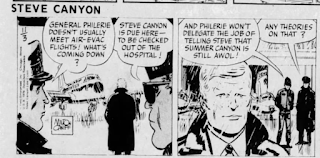
STEVE CANYON


When you've done ten or so years of a popular and successful comic strip, the inclination is to do ten more, and keep doing it until you can no longer do it. That's the comic strip business, where you keep at it because the hard work of launching a strip and building a readership is behind you. But if you were Milton Caniff in 1945 you may have also come to a different conclusion. Caniff had built 'Terry & the Pirates' into a daily part of American life. He lived well and was paid well for his work, but at the end of the day the strip was owned by the Chicago Tribune syndicate. The fate of the strip, and its profits, were out of Caniff's hands. More than anything, Caniff wanted the security for his wife that ownership would provide should something ever happen to him.

The drama of this decision is best detailed in R.C. Harvey's Caniff biography, Meanwhile... (which Harv has thanked me for endlessly plugging). But a highlight includes drawing two more months of 'Terry & the Pirates' than his contract required, so he could bring a fitting end to his 'Terry' before George Wunder took over. There was also his fear that anything he drew for the new strip, announced a year before he left 'Terry', would be the property of the Tribune. So he didn't draw anything for what would become 'Steve Canyon' until he finished out his Tribune contract. This left him with very little lead time, though more than when he took on 'Terry' in 1933, as discussed here. It's hard to imagine today the idea of a "superstar" cartoonist, but that's what Caniff was in 1947. When the strip debuted in January 1947, it was as big as "American Idol" is today.

Canyon, who started out as an ex-military pilot for hire, had been in either uniform or reserve since the Korean War. Now he was involved in Vietnam and in the next few years the tide would turn against the strip, as the public's anti-war sentiment built up and Caniff held fast to his military loyalties.This strip from May 29, 1966, is two decades removed from that auspicious debut, but there is no less respect for Caniff, given the glorious half-page berth on the comics sheet. While 'Steve Canyon' was a daily strip, Caniff was ever mindful that some folks only read the Sundays. This strip wraps up a long storyline, but what it can't do in words it makes up for in movement. Canyon (here in disguise) and the Navy chaplain have a conversation, and while it is a fluid monologue the action does not stay in one room. Caniff takes us from the chaplain's office onboard ship to a smaller boat to the port town to the military base, barracks and airstrip. This is the magic of comics. Played out in real time, the conversation wouldn't have made it off the naval destroyer. But as readers we are so caught up in the chaplain's speech that the distance traveled isn't jarring. Rather, it flows naturally. It's a great example of storytelling techniques that are unique to the comics medium as well as Caniff's mastery of it.

Saturday, October 24, 2009

FUTURE CANIFFITE


Already showing his love for Steve Canyon and Milton Caniff is my 4-day old son, Jonah. Jonah was born on October 19th at 2:50 PM weighing 8 pounds. Here at the blog I'm excited by having another son with whom I can share my love of comics, but also worried about another son I have to keep from destroying said comics.
While older brother Noah will be dressing as Captain America this Halloween, I have yet to sell my wife on the idea of Jonah as Bucky, Cap's youthful partner, as she already feels Captain America is too obscure a character!

Wednesday, October 14, 2009

DICK TRACY


I haven't read much 'Dick Tracy', which is the only reason I can give for not being a fan. I've heard many raves about it, particularly for the early stuff being reprinted by IDW under their Library of American Comics imprint. Those volumes are being compiled by our pal Dean Mullaney, the man behind 'The Complete Terry & the Pirates' series.

'Dick Tracy' was created by Chester Gould and debuted in 1931. Gould pitted his straight-shooting, square-jawed detective against an array of bizarre gangster villains, including Pruneface, Measles and B-B Eyes (some of whom showed up in the star-studded 1990 movie version).

By this May 29, 1966 strip, Gould was in his late '60s and the strip was 35 years old, it's heyday long behind it. Rick Fletcher, his assistant since 1963, would take over the art when Gould retired in 1977. This decade of strips is most notable for Gould's odd choice of having Tracy in adventures on the moon with the moon people that lived there. This Sunday seems earthbound, however, with Gould poking fun at the staid nature of his character. Tracy is showing off his collection of bullet-ridden fedoras. Note that one of his trademark hats dates back to 1931, the same year the strip debuted.

The strip is currently written by Dick Locher and drawn by Jim Brozman (example below). Locher has a long history with the strip. He was Gould's assitant the four years before Fletcher, then took over from Fletcher in '83 and was also drawing the strip until this year. Here's the link to the current strip. Sadly, it doesn't live up to Gould's quality and the most interesting aspect are the negative comments posted below the strips.

Tuesday, October 6, 2009

DICK ROCKWELL ARCHIVES


Dick Rockwell has long been the undersung and sometimes unknown factor in the success of 'Steve Canyon'. Rockwell was Milton Caniff's assistant on the 'Steve Canyon' strip from 1953 - 1988. I think his role has been somewhat obscured and diminished by history. A unique book of his was recently sold on Ebay which gives more insight into his contribution. Based on the numbers he gives us, the vintage of what's labeled 'Steve Canyon Sampler' is early '80s. I'm not sure what the book was for, but perhaps it was an attempt to get other work or even his own strip.Here's Rockwell's own description of his working relationship with Caniff -

The pencils reproduced below, particularly the before/after comparison, is a valuable insight into how important Rockwell was to the finished strip. Rockwell had to create the placement of figures/objects/backgrounds based on the pre-existing placement of words and captions and brief notes from Caniff. Caniff would ink the final strip, making it his own style. He could change things here and there, or even re-do it, but typically he rendered what Rockwell had given him.


This is to take nothing away from Caniff. By the time he hired Rockwell to assist, he was in his mid-forties and had been burning the candle at both ends for three decades. He deserved a break, and even with Rockwell's help he didn't get much of one. In addition to writing and finishing the strips, Caniff worked tirelessly to promote the feature, handle a mountain of special requests, and work with the National Cartoonists Society. By the launch of 'Steve Canyon' in 1947, Caniff had become an elder statesman of his field, though he was still rather young with a long career ahead of him ('Canyon' didn't end until Caniff's death in 1988). Rockwell remained relatively unknown to the public as Caniff's assistant. It wasn't that he languished in obscurity, or that he got a bad deal. This was how it worked in the newspaper strip business. Assistants and ghost artists (artists who drew in place of the named artist), were uncredited. In this case, both men knew it was Caniff's name that sold the strip. Rockwell was glad to have the steady gig and is clearly proud of his accomplishment and contribution to 'Steve Canyon'. When Caniff died, Rockwell was allowed to carry out the existing storyline before the strip was cancelled. His final strip was a tribute to his employer, mentor and friend -