Tuesday, March 9, 2010

CRITICAL OF THE CRITIC

A review of Douglas Wolk's 'Reading Comics'


Way back in this post I maligned the title of Reading Comics by Douglas Wolk, without having read it. Actually, I was critical of the subtitle - 'How Graphic Novels Work and What They Mean.' It's overly pretentious. Who was this guy to tell me what how to read comics? My pal Ted Haycraft responded to the post by getting me a copy of the book. I finally got around to putting some thoughts together.

Wolk's book is divided into two parts: 'Theory and History' followed by 'Reviews and Commentary'. I haven't read the second part, as it's mostly 10-30 pages reviews of things I haven't read, or have read and forgotten. I'm sure I'll pick at it later, like a salad bar, but for now the first part is what holds my interest.

Comics have grown up, Wolk tells us, but had an "awkward childhood and difficult adolescence." I'm not sure of his meaning here, unless "awkward" means a fast-growing mass media that was enjoyed by millions, which is what comics were in the 1930s and '40s (nostalgically referred to as comics' 'Golden Age'), and "difficult" refers to an resurgence of creativity in the 1960s (the 'Silver Age'). I also thinks he overstates the importance of DC Comics' 'Showcase' #4, considered the first comic book of the Silver Age. I really think it was Marvel Comics that brought the industry back to life in the 1960s, along with the popularity of the DC characters in their 1960s incarnations had fans working backwards to find the starting point of this new era. At the same time he maligns 'Showcase' #4 by saying "[t]he cover's text and art reveal fumbling confusion over what exactly it is advertising." Fumbling confusion from artist Carmine Infantino and logo pioneer Ira Schnapp? Hardly. Fumbling confusion from the reader, then? Only if you never saw a comic rack or were unfamiliar with a medium that had been around twenty years by then.

These quibbles aside, my main issue is with the crux of the book, which is based Wolk's assertion that "the big, awkward question hanging in the air is how to read and discuss comics now that they're very different from what they used to be." In this era of comic book news websites, message boards and blogs, comics are being discussed more now than they ever were. There is no question of how to do it, unless you think from a purely academic perspective that people are doing it wrong. Anyone can read a comic, then go on the web and become immersed, to the point of obsession, in the world of that comic, sometimes including interaction with the creators of that comic.

Ironically, Wolk himself criticizes the snobbery of the literati who deign to come down from on high to review comic books, but feel they must give them lofty titles, like "graphic narrative" so as not to sully their mindset as to what represents art and what doesn't. He's dead-on in this assessment, rightly assailing those who don't recognize that 'comics' or 'comic books' are a medium to tell any kind of story, like movies or novels. It's not a great name for acceptance by the New York Times Book Review, but we're kind of stuck with it and should embrace it. It's like those who now refer to monthly comics, something they purport to love, with disdainful names like "floppies" or "pamphlets", as if to say they are lesser versions of a greater form.

Wold paints things with a broad brush. He derides comic adaptations of movies ("pointless cash-ins") and novels ("uniformly terrible"). While I agree with his opinion on movie tie-ins to some degree, some of this work is respected and beloved, such as the first 'Star Wars' trilogy adaptation, which is still in print. As for novel adaptations, such as the long-running 'Classics Illustrated', these were meant to introduce children to classic works, not supplant them. He also knocks CrossGen as "terrible" across the board, leading me to believe he didn't read any CrossGen, or missed excellent reads like 'Way of the Rat' and 'El Cazador'.

OK, now to the good stuff. Wold hits home when he criticizes comics' fans thrill and excitement when comics are mentioned in the mainstream press. I'm guilty of it; comic fans, blogs, news sites and message boards are guilty of it. 'Did you see that piece on R. Crumb in USA Today? We've been legitimized!', or as Wold aptly puts it, fans feel "they have to prove their favorite leisure activity worthy of respect-to show the world that they were right all along."

Most importantly, Wolk's book got me thinking about comics. It has challenged me to think about why I like comics. I don't think I ever really thought about it. I know I like comics as a medium. I know what I like and don't like. I just never thought why I like what I do like, beyond that I liked the art and the story. I'm still not sure I have well thought out answer. But as a supposed writer, being able to articulate my points and think more deeply about the subject of comics, now firmly embedded in my DNA, would be a valuable tool. So, on that basis I can recommend the book. However, on the basis of his description of some superhero comics fans as "pathetic" and "desperate", and his overall Groth-esque elitism, I cannot recommend it for the general comics reader. It turns out my instincts about the subtitle were correct.

Wednesday, March 3, 2010

CANYON MONTAGE


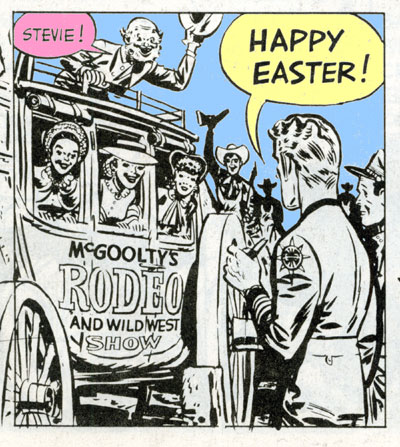
I haven't posted much about Milton Caniff lately, so to correct that here's a nifty color Sunday strip from July 21, 1968. I'm really interested in how this montage was put together, so please share your thoughts (especially R.C. Harvey, if you're out there). It looks like a cut and paste job of old strips, but what was the source material? I assume they were photostats from his own files. But how did he get them the size he wanted, assemble it altogether, etc. Because in a pre-Photoshop world, this must have been a meticulous exercise. My only other question - we see plenty of Steve's supporting cast from over the years, but where is Happy Easter?

As a bonus, this was on the other side of the 'Canyon' strip. It's another Caniff creation, 'Terry & the Pirates', which had been written and drawn by George Wunder since 1947. Wunder's 'Terry' suffers from some anonymity, owing to near complete lack of reprint collections. I'm not a big Wunder fan, but his color Terrys are hard to come by.

Tuesday, February 23, 2010

SAY IT'S OUR BIRTHDAY

Why do we care about famous people's birthdays? They don't care when it's my birthday, right? And they didn't do anything famous by being born. Shouldn't we celebrate the anniversary of the first time they did something famous? Like me, for instance, we could celebrate the anniversary of my blog (11/09/2007), instead of February 27th (my birthday! send presents!) Anyway, it's kinda kooky, but I had fun looking at some famous folks who share my birthday...

Howard Hesseman ('40) - Wow. Dr. Johnny Fever is 70. I'm a big fan of the original "WKRP in Cincinnati", and I didn't know we shared a birthday until compiling this list. I also liked his other show, "Head of the Class", and even remember him on "One Day at a Time", when he played Ann Romano's new husband, Sam, in the last two seasons. I enjoyed the first season of "WKRP" on DVD. I think too much was made over the fact that the music was changed from expensive-to-license rock classics to generic rock. The comedy wasn't in the music! I hope to someday see Seasons 2 & 3 out, but no announcements have been made.

Ralph Nader ('34) - I first saw Ralph Nader on "Phil Donahue", probably sometime in the '80s. He was talking about single payer health care back then, and he may get his wish here before too long. I met him when he spoke at my college and got to ask him about his appearance on "Sesame Street" ('A consumer advocate is a person in your neighborhood'...here's the awkward video) I've always liked Nader as a person, even though we disagree on most things. I liked his 'two party system be damned' approach to running for president, and not going quietly when he was shut out of the debates. I'm still not sure how I feel about third parties being excluded from debates if they're not polling at least 15%. On the one hand you don't want to exclude ideas, but on the other hand you want to hear the candidates who have a chance of winning (though they let McCain debate last time).

Elizabeth Taylor ('32) - Should I be embarrassed that I've never seen an Elizabeth Taylor movie? That I've never seen her act outside of a White Diamonds commercial? By the way, how old is that White Diamonds commercial they run every year around Christmas? I think it was on when I was in high school. It may even be older than the Hershey Kisses/bell ringing ad, or the "12 Days of Xmas/5 roast beef sandwiches" Arby's spot. I think historically she'd prefer to be remembered this way instead of this way (start at the 6:30 mark).

John Steinbeck ('02) - A staple of high school English classes, I recall reading 'Grapes of Wrath' and 'Of Mice and Men'. I can't remember if we read 'The Pearl' or just saw the film. 'Mice' seems to be the most universal, judging from its many film adaptations in English and other languages. My favorite version is the Gary Sinise/John Malkovich one, with Ray Walston as Candy. I also didn't realize until looking for a picture of Steinbeck just how much he resembles Mitch Miller.


David Sarnoff (1891)- As a former broadcaster, it was fun to learn that I share a birthday with broadcasting pioneer David Sarnoff. Sarnoff lived the American dream - a poor Russian immigrant who became his family's means of support at age 15. He worked his way up at the Marconi telegraph company, which would become RCA. By 1930, Sarnoff was president of RCA. Having built a successful radio business with subsidiary NBC, he turned to television technology as the next big thing, with NBC as the first television network. He retired in 1970, having lived the history of broadcasting in America, from the telegraph to The Governor & JJ.


Constantine I (272) - 1700 years before me, this future Roman emperor, Flavius Valerius Constantinus, was born. I don't remember much about this guy and my high school world history notes aren't handy (but yes, Mr. Rudisell, I still have them). So, I must rely on Wikipedia, which tells us that Constantine the Great was the first Christian Roman emperor. That he ruled from 306 to 337 and spread an edict of religious tolerance. He also built a new capital, Constantinople (now Istanbul). Wikipedia goes on to say that Constantine love music, and had a band on the side called Little Connie and the Imperials. He also collected dinosaur bones, had eighteen wives and invented the ladle (or, in Latin, 'spoonus for soupus'.

Saturday, February 20, 2010

SATURDAY EVENING POST, February 24, 1940

[photo by Lincoln Borgham]
Seventy years ago this week, the magazine above was on the newsstands. What strikes me as odd is the photographic cover on a magazine known for its illustrated covers. This is in contrast to the Noel Sickles painted cover for LIFE magazine, which was known for its photography, that I wrote about here. The interior of the magazine is packed with illustrations, both in the content and the advertising. I guess what's most amazing to me is that a magazine that presented short stories and articles accompanied by illustrations was one of the most popular magazines in the country. Before television, did folks really stand around the water cooler and discuss the latest short stories? Find an octo- or nonagenarian and get back to me. Meanwhile, in the tradition of one of my favorite blogs - Golden Age Comic Book Stories, I present a sampling of illustrations from this issue, with artist annotations but without comment. Some of the artists are unknown to me, so if I recognize something let me know.

F. R. Gruger


Stevan Dohanos


Mortimer Wilson
Denman Fink


George Brehm
Matt Clark

Ford ad [artist unknown]

Casite ad [artist unknown]


Champion sparkplugs ad [signed in lower right, but can't make it out]

Texaco [artist unknown]

Thursday, February 11, 2010

CAPTAIN AMERICA & THE TEA PARTY

Over two weeks after its release, Captain America issue #602 caused quite a controversy over an overt political message in one of the comic panels. The story broke on 2/8 after Warner Todd Huston took exception to the content of the issue. Fox News picked it up and the comics blogosphere and others followed, becoming a big enough story that even my wife knew about it. Being a 28 year reader of 'Captain America', beginning with issue #274, and a supporter of the Tea Party movement, I feel compelled to weigh in. [SPOILER ALERT - if you don't want to know what happens in #602, read no further!]

A bit of background for the non-comics folks - The current Captain America is Bucky Barnes, Cap's former junior partner. Barnes agreed to become Captain America after the apparent death of the original, Steve Rogers. Though now Rogers is alive and well, he's asked Bucky to stay on as Cap. In this story, entitled 'Two Americas: Part 1', Captain America is joined by his friend the Falcon, also a former crime-fighting partner of Steve Rogers. They've gone to Boise, Idaho to infiltrate the Watchdogs, a violent militia group whose goal is to impose their values of morality and decency by force. They are a high-tech threat, using military gear to carry out their goals. They have fought Captain America on and off since their 1987 debut. Upon arriving in Boise, the pair come across this demonstration - Falcon says, "Some kind of protest rally...looks like some kind of anti-tax thing." Falcon, who is black, then voices concern about their plan of infiltration, because he doesn't think he'll fit in "with a bunch of angry white folks." Bucky tells him that it's all part of the plan, that it's "perfect". That night they go to a bar, where Falcon poses as an IRS agent. Bucky poses as a trucker who beats up the IRS agent, drawing the attention of some Watchdog members who are there and could use a guy like that. The story is then 'to be continued' next issue.
The signs in the above panel are the main source of the controversy. Huston's article accuses Marvel Comics of attacking the Tea Party movement as a bunch of racists who want to overthrow the government. I think Huston connects too many dots. Yes, the protest is clearly a Tea Party rally. Who else is having anti-tax, anti-big government rallies these days? Huston complains that the crowd is all white. Well, it is Boise, Idaho, which as of the 2000 census was 92% white and less than 1% black. It's the people of Boise who should be complaining, as artist Luke Ross makes it seem like they gathered all the Wal-Mart shoppers and carnival workers of southern Idaho into one spot. We also never see any racism on the part of the people at either the rally or in the bar. The only racism really is on the part of Bucky Barnes, who assumes the people of Boise are racist. "And don't forget your briefcase, Obama!" he chides as he throws Falcon out of the bar. Marvel editor-in-chief Joe Quesada has asked readers "to read the whole thing and not just judge a story and its intent on the first issue." This storyline lasts four issues, so I hope they address some of the galling racial assumptions.

Quesada made those remarks to Kiel Phegley in this article on Comic Book Resources.com. He claims that the writer, Ed Brubaker, did not intend for the protest to be a Tea Party protest. Quesada's explanation is that in the original art the signs were blank, so the book's letterer, Joe Carmagna, was asked to put something on these signs. He innocently found these signs on line and put them in the blanks. They never meant to show a political agenda, or offend anybody, or blah blah blah. Nonsense. Marvel wants to have it both ways. They want to be the company whose characters live in the "real world" (e.g. New York and not Metropolis), but then they present a real world situation and it's just some protest group in comic book land. They just don't want to offend half the readership, or by extension the larger audience they want to buy tickets to a 'Captain America' movie in 2011. Then there are the political leanings of the creators. Given that the internet is all-seeing, someone recovered some of Brubaker's tweets, such as "Memo to [Michelle] Bachman and the rest of the tea crowd -- We had a revolution already, it's called an election." I wonder if he would have said the same thing to the war protesters in 1970 - 'Hey, Nixon won. Get over it!' How else do I know that it's intentional? Because the comic works without the protest scene. The page before the protest scene, Bucky and Falcon land in Idaho.
Falcon - "And just how do we go about infiltrating a grassroots anti-government army?"
Bucky - "I've got an idea...but I don't think you're gonna like it."
Falcon - "Oh great..."
Then you can skip the next two pages with the protest, go directly to the bar scene, and it all makes sense. I'll hang with this story because Brubaker's one of the best writers 'Captain America' has ever had. He saved the book after it had been mishandled for years by writers who didn't know how to write a good Captain America story. So, I normally trust him to take me somewhere, it just seems a little sloppy right now.
The "Tea Bag" sign doesn't bother me. That's an example of someone trying to deflect the insult of others. Liberals just feel super-clever every time they refer to Tea Party activists as "tea baggers", adding more vulgar overtone than actually exists for a fairly mundane sex act. No, the sign that bothers me is the most popular - "America not Americant". Shouldn't it be "AmeriCAN not AmeriCAN'T"? It doesn't make sense the other way. Marvel has promised to change the "Tea Bag" sign when they collect the comic book in trade paperback. Even without it, the intent will be clear.

Monday, February 8, 2010

WATTERSON POST CARTOON - 30 JUN 1980

Bill Watterson was in the news last week after he granted the Cleveland Plain Dealer a rare "interview" (answering questions via e-mail). I also learned that in the early '80s, after he left the Cincinnati Post he continued to draw editorials for the Sun Newspapers. They've posted a nice archive, with better quality than my scanned photocopies of scratchy microfilm. It was an interesting coincidence that it came out the same week as the death of J.D. Salinger, as both are famous for their reclusive natures. Watterson hasn't published any art in the 15 years since ending 'Calvin & Hobbes', and has remained elusive to reporters and comics fans who try to track down his whereabouts.

[click to enlarge]
In this strip from June 30th, 1980, Hamilton County and the city of Cincinnati were at odds over money to build a new jail for "low-risk" prisoners while a new county jail was being built to replace the Cincinnati Workhouse in 1984. The Workhouse was a massive building that dated back to 1870. It was still in use after the Hamilton County Justice Center was completed, on a limited basis, until it was demolished in the early 1990s.

In an 'everything old is new again' vein, the lack of adequate jail space is still a hot button issue for Cincinnati and Hamilton County. A 2007 levy to build a new facility, in addition to remodeling the existing jail, failed by a wide margin. The result is a revolving door justice system where some offenders are released because there's no space and others are shipped to jails in neighboring counties at taxpayer expense. The cops of today are feeling the frustration of the cops in Watterson's cartoon, going after the bad guys but having nowhere to put them.

Tuesday, February 2, 2010

A REPLICA BY ANY OTHER NAME...

Want to dress up as your favorite super hero? Not happy with the plastic facsimiles that came with your Ben Cooper costumes of 30-40 years ago? Have no fear, true believer! Costume replicas are upscale these days. Witness this latest entry...

What little girl in the '70s didn't want to wear Wonder Woman's tiara, bounce away bullets with metal wristbands, or wrap up criminals in a magic lasso? Well, now those girls (and probably some boys) can get their chance. Or can they? I was upset by the disclaimer in the corner of the ad - NOT TO BE WORN OR USED AS WEAPONS. Not to be worn?!? Why else would I want this thing? Don't they know the Iron Man helmet is too cumbersome to be worn while driving (or so the cops keep telling me)? The tiara is the perfect solution. The wristbands may not be bulletproof, but that's ok. I don't exactly have the reflexes to move my arms in the path of random oncoming bullets. And the lasso may not force it's captives to tell the truth, but aren't there some truths I don't want to know (especially when I'm in a tiara and gold bracelets)?

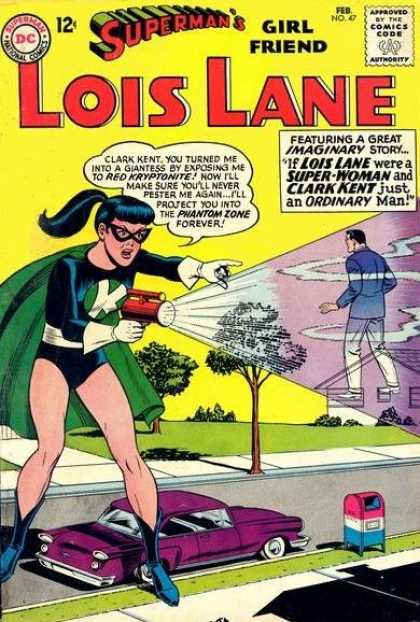
There's something a little grim about the whole "trophy room" concept. Wouldn't I have to kill Wonder Woman to get this stuff off her? And then you get it home, and it's shiny in it's replica-ness and all, but your wish fulfillment is left a little wanting. I've suffered through web-shooters that don't shoot spider webs, Bat-Signals that summon no one, and Red Kryptonite that doesn't turn Lois Lane into a super-giantess. I know why my Star Trek communicator doesn't work. The Starship Enterprise is out of range (duh!) Ok, I do have one replica that does work. My Green Lantern ring. Yeah, baby!

The JLA Trophy Room: Wonder Woman Tiara, Bracelets and Lasso Prop Replica is available for $325 from your favorite comics retailer.
Special thanks to Kendall Swafford (props & original photo) and Eric Wagner (super colossal photo editing).