Monday, June 28, 2010

CAPPY DICK


May 29, 1966

I was sad when 'Cappy Dick's Young Hobby Club' disappeared from the Sunday funnies, sometime in the late '80s, and I'm not sure why. 'Cappy' gave a weekly dose of tips for making your own fun. Take peanuts and twigs and make your own mini-tomahawks, for example. Paint pasta and make a necklace. Take an egg carton and buttons and make your own tiddly-wink-style game. I have no childhood memory of ever trying anything I read in 'Cappy Dick', but I remember when it was suddenly gone one Sunday, feeling the disappointment you feel when a piece of your childhood fades out.

Unlike some strips, the web is no fount of information when it comes to 'Cappy Dick'. This page has a great overview, as well as a nostalgic dream of a kid wiling away his Sunday with the craft ideas learned from the strip. I did find an obituary for the Cappy's creator, Robert Cleveland. He died in 1985, at which time the strip was being carried in 64 newspapers. Cleveland was no longer drawing the strip at his death, as it had been taken over in the '60s by 'Buck Rogers' artist Rick Yager. The strip ended in 1987, with cartoonist Bob Weber, Jr. transitioning from 'Cappy Dick' to his own Slylock Fox, which focuses on rudimentary drawing tips and "spot the difference" exercises. I think the only way a hobby strip like 'Cappy Dick' would make it today is if it was renamed 'Cappy Dick's Cheats for Nintendo DS'.


Monday, June 21, 2010

CINCINNATI COMIC EXPO - COMING IN SEPT.

I was surprised yesterday to learn about the Cincinnati Comic Expo, a one day comic book show coming up on September 18th. Cincinnati has historically not been a comic show town. Columbus has two well-known shows - Mid-Ohio Con and S.P.A.C.E. Further out, Chicago now has two large shows - Wizard World and C2E2. For some reason, Cincinnati hasn't supported a show, even small ones like they have in nearby Dayton and Indianapolis. That changed last year with the Comic City show in November, which I wrote about here. While it was a small show, it was quickly purchased by convention powerhouse Wizard and renamed Wizard World Cincinnati.

How come Cincinnati doesn't have its own show? Before last year, no one seems to remember one after 1999. I talked with Cincinnati Comic Expo co-founder Andrew Satterfield. He was stumped, as well, given the size of the city and its centralized position amid other cities. Perhaps it's that other cons have been announced and never happened. Twice now, something called Pop Culture Con has been promoted, only to be cancelled. But its presence and then failure may have scared off others from doing a show. Wizard World Cincinnati has a website, but no date, and it's unlikely they'll have a show in 2010 with the year half over. "I'm not waiting anymore," said Satterfield, who wants to start with a quality one day show, with ambitions to expand it in future years. What about dealers, exhibitors and fans who have made plans before, only to have the show disappear? Satterfield wants to reassure them. "It will happen," he says.

Satterfield also wanted to stress that the guest list won't be rife with aging sitcom actors or wrestling stars. "We're focusing on comics," he said evidenced by the show's name and the current guest lineup. The featured guest is Michael Uslan, executive producer of 14 Batman movies, live action and animated. Uslan is also a comics historian and author of several comics histories. In a Caniff connection, Uslan wrote the 1995 revival of the 'Terry & the Pirates' comic strip. It will be interesting to meet another guest, Allen Bellman, a Golden Age artist I'm not familiar with at all. According to his bio, he worked in the early '40s on my all-time favorite character - Captain America. I'm most looking forward to seeing Russ Heath again. Heath, still spry at 84, is a heck of a nice guy I've met a few times at Chicago shows. Heath started working comics in 1948, drawing westerns for Timely/Atlas. His most celebrated work are the war stories he drew for DC Comics from the '50s to the '70s, part of the pantheon of legendary war artists John Severin, Ross Andru, and Joe Kubert. As I said, he's still at it, most recently drawing covers for Dave Sim's Glamourpuss.

The Cincinnati Comic Expo will be held from 10AM - 5PM on September 18th at the Cintas Center, located at on the campus of Xavier University in Cincinnati, Ohio. Children under 10 are free with a paying adult.

Monday, June 14, 2010

BEETLE BAILEY


Is there much more reliable in our lives than Beetle Bailey? The venerable comic strip is celebrating its 60th anniversary this year, a fixture of the funny pages for most of our lives. What's comforting about Beetle Bailey is the endless repetition of running gags performed by the wacky cast of characters based in the Army's mythical Camp Swampy. Some may try to ascribe higher meaning to this...a metaphor perhaps for the dullness of military life or even the sameness of life in general. I think it's more that these are jokes that have always elicited a chuckle, and it ain't broke, keep drawing. Even after 60 years, there's still comedy to mined in new twists or nuances on old gags -

The guiding hand of strip creator Mort Walker is also what makes 'Bailey' special. Though he now relies on a team of five to create Bailey gags and art, Walker is right in there at 87 with writing and drawing and having final say on whatever his collaborators, which include his sons Greg, Neal and Brian, produce. There's a great sampling of strips on BeetleBailey.com. Readers can vote for their favorite to be reprinted in the two weeks surrounding Beetle's anniversary. The strip will also be honored next month with its own postage stamp. The 'Sunday Funnies' stamps will honor five comic strips. The dedication ceremony will take place on July 16 at Ohio State, and guests include Walker, Garfield's Jim Davis and museum curator Lucy Shelton Caswell. More details on the dedication can be found here. While at Ohio State, Walker will no doubt visit the Billy Ireland Cartoon Research Library and Museum, and with good reason.

Few have done more for the preservation of comic strips than Mort Walker. Believing in the medium as an art form equal to others, he founded the Museum of Cartoon Art in 1974, later adding "International" to the front of the name. The museum had several lives, starting in Connecticut and ultimately locating in Florida, where lack of funds forced closure in 2002. The collection has since merged with the Cartoon Research Library's collection, prompting them to add "and Museum" to the title. The recognition and preservation of Walker's own work is currently on display at a different museum, the Cartoon Art Museum in San Francisco.
There are several 'Beetle Bailey' books out there. The strip was well-represented in the comic strip reprint paperback heyday of the '60s and '70s, with over 100 titles to its credit. Currently, there is a book reprinting the earliest years of the strip, 1950-52. This is from Checker Book Publishing, the same folks who bring us the 'Steve Canyon' reprints, albeit infrequently. I'm not sure if they were planning further volumes, but Titan Books is skipping ahead and reprinting all of the 1965 strips in a book due in October. There's no special 60th anniversary book, but the 50th anniversary book can still be found around, though avoid this guy who wants $185! What you shouldn't avoid, but rather seek out, is the Mort Walker interview in the Comics Journal from last year. Interesting stuff for Bailey fans and fans of comics history in general, conducted by Caniff biographer R.C. Harvey.

At the top is the Sunday strip from May 29, 1966. The Cincinnati Enquirer gave 'Beetle Bailey' a full half page, a testament to its popularity. It's ironic that a strip ideal for the way comics would shrink in the '60s and '70s, with its simple figures and backgrounds, was given so much space. How much space? 13" x 9.5"...almost a full square foot! Contrast that with today's 10 1/8" x 3 3/8", less than a quarter of a square foot. It's the same issue I talked about last year with Blondie. I'm just glad it hasn't gotten any worse.

Friday, June 4, 2010

GARY AND RUE

I grew up watching Gary Coleman. From age 6 to 14, I was there for every show. My 10-year old Saturday nights were all set, with "Diff'rent Strokes", "Silver Spoons" and then the "Love Boat"/"Fantasy Island" combo. So, I saw it all - the rabies epidsode, the appendicitis episode, the two-parter where they were hostages in a bank, guest shots by Mr. T, Muhammed Ali and Nancy Reagan, and that one with Gordon Jump as a creepy pedophile. Yes, I even stuck around for the last two seasons when Mr. Drummond remarried a woman (played by Dixie Carter, also recently deceased) with a cute moppet of a son, replacing college bound Willis (who appeared intermittently) and Kimberly (a pregnant Dana Plato, who had been fired).


I followed Coleman's intermittent exploits after the show. I watched the "Diff'rent Strokes" reunion on Geraldo in 1993, in which Coleman admitted to having attempted suicide. Geraldo asked Coleman if he was working on any projects. Coleman responded that he and a friend were working on a hybrid sitcom/movie review show and then asked the audience what they thought of the idea. He received some slight sympathy applause. Just recently he took his marriage woes public with an appearance on Divorce Court. Apparently he forgot to ask, "If I'm bleeding to death, will you help me or run upstairs because you don't like blood?"

I also watched Rue McClanahan in her many incarnations. While I don't really remember her from "Maude", I'm sure I saw episodes somewhere in childhood. Before her major success in "Golden Girls", I knew her best as Aunt Fran, Thelma Harper's sister on "Mama's Family". In that series' pilot, homebody Fran is the most resentful at having Thelma's son and his family move into Mama's house and disrupting her quiet routine. Though revived later in syndication, the network demise of "Mama" after two seasons was a career boon for McClanahan, as well as Betty White, who had a recurring role as Thelma's daughter, Ellen. Both moved to the sunny skies of Miami with Bea Arthur and Estelle Getty. There McClanahan had her best-remembered role, as bed-hopping cougar Blanche Devereaux. "Golden Girls" was a big hit, and continues to run a whopping 12 times a day on cable (4 on the We Network, 8 on the Hallmark Channel).
What impresses me most about McClanahan is her range. Skittish, dowdy spinster Aunt Fran is the opposite of the oversexed, confident Blanche, both of whom she played convincingly. Somewhere in the middle is Vivian Cavender, the best friend role she played on "Maude". Perhaps the name Vivian was a nod to Vivian Vance, Lucille Ball's perpetual pal. Except Maude wasn't goading her Vivian into zany schemes, and Ethel never gave Lucy advice on having an abortion.

While their paths of both Coleman and McClanahan only crossed in TV land (literally, at the 2008 TV Land Awards), both did share a series co-star, Conrad Bain ("Maude", "Diff'rent Strokes"). Also, Coleman guest-starred on two episodes of "Good Times", which was a spinoff of "Maude". McClanahan also co-starred with Dabney Coleman in a short-lived series called "Apple Pie". To my knowledge, Gary and Dabney Coleman are not related. Yes, it's a sickness I have.

Friday, May 28, 2010

APARTMENT 3-G


I read 'Apartment 3-G' as a kid on Sundays. But we didn't get the paper with the dailies, so I never really knew what was going on. I probably wouldn't have read it even if we did, as it's a "soap opera" strip in the vein of 'Mary Worth'. So I'm not well-versed in the adventuers of Margo, Tommie and Lu Ann, but I'll try to give some background for the strip above. [click to enlarge]

'Apartment 3-G' began in 1961, written by Nicholas Dallis and drawn by Alex Kotzky. Dallis was a licensed psychiatrist who was by this time a strip veteran. He was already writing his co-creations 'Rex Morgan, M.D.' and 'Judge Parker', though under separate pseudonyms to protect his medical practice. By 1961 he had retired from medicine, so I guess that freed up time to create '3-G' with Kotzky.

Kotzky started out as a comic book artist, best known for his post-war work with Quality Comics. After the comic industry meltdown in the early 1950s, he moved on to advertising illustration (where the money was) as well as freelancing in comic strips. I'm not sure how Kotzky was picked for 'Apartment 3-G', but his ease at drawing beautiful, modern women must have been a factor. Dave Karlen as the story on Kotzky, along with some beautiful original art, over on his blog. Kotzky drew the strip for over three decades until his death in 1996. He was succeeded by his son, Brian, a paperback cover artist who illustrated over 100 Hardy Boys novels. He was succeeded in 1999 by Frank Bolle, another comic book veteran and contemporary of Kotzky's. The modern strip has its own fans, such as this blogger who views the ladies of Apartment 3-G as something of a 'Sex & the City' prototype. Here's a recent sample of Bolle's strip, a Sunday from 05/26/10 -

Kudos to Frank Bolle, something of an undersung artist who did most of his comic book work for Western Publishing. He's in his late '80s and still drawing a daily strip. Plus, he used to draw really cool stuff like this -

Wednesday, May 19, 2010

HIDDEN MASTERWORK

One of my stops on the 'Noel Sickles Tour' of Chillicothe, Ohio, was the Carnegie Library where Sickles haunted the art stacks. My eyes were drawn toward, hanging unassumingly on the wall, what appeared to be some kind of Victorian masterpiece. The pictures I took of it were blurry, so I didn't blog about it at the time. Thankfully, we stopped again on my return trip. I was able to get better pictures and find out some information.

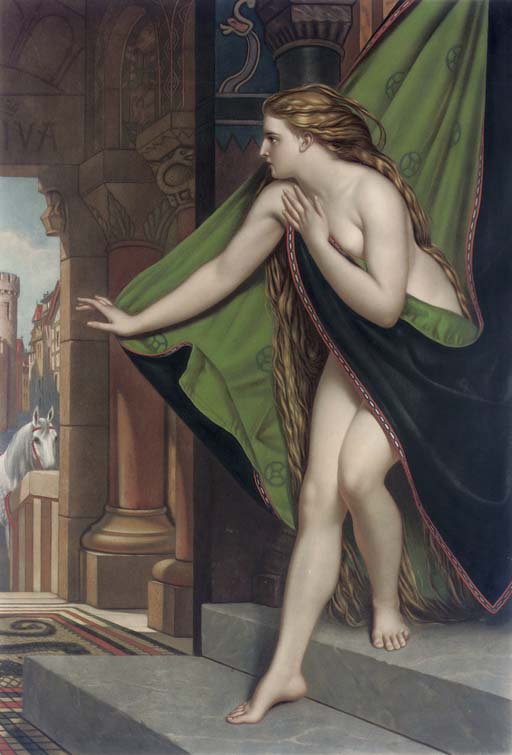
All I had to go on in 2007 was the name in the corner - Van Lerius. Thanks to Google, I was able to find the artist's full name and a picture of the painting. Well, sort of. Apparently this painting was important enough to make an intaglio plate engraving so that copies could be made. These copies are still being sold today. So, was that it? Was this a copy hanging on the wall? I didn't think so. The massive frame indicated age and stature. The colors of the painting do not match the colors used on the engraving, although those could have changed over time. No, I convinced myself, this was the original, whatever it was.Joseph Henri Francois Van Lerius was a Belgian painter of the 1800s. He attended the Royal Academy of Fine Arts in Antwerp, later becoming a professor there from 1854-76. He was best known for his painting of Lady Godiva. The painting above is known as 'Cinderella and Her Sisters', or sometimes just 'Cinderella'. In 1860, the painting was on display at Schau's Gallery in New York. A reviewer said it showed "all the beauties, and some of the defects, of that artist's style."1 The reviewer alludes to the engraving having been done by Atkinson in London between a previous New York exhibition and 1860. In 1861, it was at Robinson's Gallery in Philadelphia. A local magazine called it "a work of rare merit."2 According to the New York Times, it returned to Schau's later in 1861. In 1874, 'Cinderella' was one of three Van Lerius paintings representing Belgium at the International Exhibition in London. Critic Bernard Becker also raved about 'Cinderella', remarking on "the wonderful texture-painting" and calling the story "excellently told."3

The painting's provenance is unknown between 1874 and 1909, but during this time it came into the possession of A.L. Fullerton, a wealthy Chillicothean who had been on the Board of Education and the library's Board of Trustees. A report in the Scioto Gazette from February 1909 related that Fullerton gifted the painting to the library. I'm guessing Fullerton was instrumental in the library's formation, as the article eludes that he was "intimately associated" with this six year old institution.4 Now here we are, a century later, and a it's still hanging in the library, probably where it was originally placed "so it would get a good light so as to reveal its beauties."


The magic of Photoshop Elements reveals more details in Cinderella's chimney corner.


1The Crayon, New York, December, 1860
2Arthur's Home Magazine, Philadelphia, January, 1861, p.252
3Journal of the Society of the Arts, London, May 22, 1874, Bernard H Becker
4Scioto Gazette, Feb 9, 1909

Monday, May 17, 2010

WONDERFEST 2010

I have long heard about the wonders of Wonderfest, the annual sci-fi/horror/monster movies and models convention in Louisville. So this year I decided to join my friends, who are longtime Wonderfest boosters, to see what it was all about.

In the mid-1990s I met fantasy artist Ken Kelly at a Capital City Distribution trade show. I was struck at the time with how easygoing and gracious Ken was. Well, only our hair has changed as he gladly helped me recreate the scene in the photo below - photo by Jim Alexander

A draw for me this year was the premiere of 'Aurora Monsters: The Model Craze That Gripped the World'. As the documentary explains, the classic monster movies of the 1930s and '40s were syndicated to television in the late '50s as "Shock Theatre". This created a nationwide craze for Dracula, Frankenstein, et al., which led to merchandising and the creation of monster model kits by Aurora Plastics. Kids who grew up with these kits and still have a passion for them are called "monster kids", and they fuel much of what goes on at Wonderfest. The documentary was worth the trip, particularly the interviews with artist James Bama and sculptor Ray Meyers. The film is hosted throughout by Zacherley, the dean of TV horror hosts, now a spritely 91. To order this DVD, go here.
Even better than Ray Meyers on the documentary was Ray Meyers in person. Meyers sculpted the figures for several of the model kits. A true artisan, Meyers brought his electric drill and bits as well as an example of the acetate plastic he sculpted from. At 90, Meyers is engaging, humorous and still well-versed in his craft and the work that he did. After Aurora, Meyers went on to sculpt toys for Kohner Bros and collectibles for the Franklin Mint. Meyers was very pleased and surprised that there was so much interest in the work he did half a century ago. He remarked several times about the standing ovation he received at Saturday night's award ceremony, somewhat astonished at all the accolades that fans felt were long overdue.
Aurora enthusiast Jim Alexander asks a question.

The model 'contest and display' room was packed with rows of finished models. Most of them are faithful and intricate reproductions of characters and vehicles from beloved movies and comics. There was a special display of models for 'The Empire Strikes Back'.

Some modelers include a bit of whimsy. You can't read the card in the lower right, but basically the creator has some story about an AT-AT trying to 'help up' a fallen comrade.
Some of the models are existing kits put together with expert skill. The mind-blowing models are those that are built from scratch. For example, this model based on a controversial comic book cover.

James Karen was one of the guests of the show, mainly due to his role in the 'Return of the Living Dead' films. He's one of those actors you've seen everywhere. I know him best as Craig T. Nelson's boss in 'Poltergeist'. He's been all over television, including a "M*A*S*H", as the villain in the last 'Little House' TV movie, and the "Seinfeld" episode they never show because Kramer stomps on the Puerto Rican flag. I didn't get to meet James Karen, but my pal Ted Haycraft scored this autograph for me (thanks, Ted!).